

Kiyoshi Kurosawa’s Kairo (Pulse, 2001) often makes lists for the best horror films of the twenty-first century, if not of all time. It’s still an unnerving watch, a slow (until-it-isn’t) apocalypse brought on by the unknowable potential of the still-relatively-new internet. At this point of anticipation of what the millennium might have brought, strange sites and unfamiliar connections between devices offered an exciting, unexplored landscape for the genre, a seemingly unfamiliar frontier of the unknown to fear. Who is out there? What do they want? What are they? In the case of Pulse, they are the undead, freed from their underworld by technology and ready to reemerge through our devices. But where Pulse is a movie about the horror of possibilities, Kurosawa’s latest, Kuraudo (Cloud, 2024), instead confronts the horror of limitations, like he is looking back at the naiveté shared by so much of the world in 2001 about the new age and its central technological update and revisiting the subject with the hindsight that everything has turned out to be much dumber and more cynical than his overtly mystical first take.
Cloud, as a blatant revisiting of a contemporary classic from the same director a quarter century later, reminds me in several ways of David Fincher’s underrated The Killer (2023). Where Fight Club (1999) tapped into the potential for domestic radicalization, societal breakdown, and the loss of the self within the expectations of late capitalism, The Killer offers a much simpler, funnier rebuttal: you are your job. That’s all there is. If your self worth is tied up in that, you might remember that the rich guy who profits from your perfectionism doesn’t care about you, and you aren’t Tyler Durden. Even if you were, you wouldn’t matter. Good luck. Kurosawa similarly takes the horror of Pulse and offers a simpler explanation for the incredibly stupid internet age: everyone is hustling to make a quick buck, no longer much aware of the distinction between concepts like real, authentic, or fraudulent, and everyone is incredibly angry. They’re angry at this world, at the fact that they can never get ahead, but they, too, are not Tyler Durden. Where they might have been lulled into a Project Mayhem of grand proportions 25 years ago, today they instead find some other hustler on the internet who they can victimize as a kind of systemic catharsis and then commodify the violence, because, you see, there is no mayhem that isn’t commodified on some level in the internet age. There is no rage that can’t be purchased by someone.
And, in the land of those blinded by the infinite petty resentments offered by the internet, the man who still has an eye for profit may be close enough to being a twenty-first century king. The kingdom where much of Cloud takes place is a lake-house rented by Ryosuki Yoshii (Masaki Suda) with the proceeds from his side-gig-turned-main-gig reselling products of dubious quality as if they are designer and producing a scarcity of supply for boutique items that he can then offer at a conveniently inflated new value. Things seem to be going well for him, if not for his consumers or the producers who can’t find the same value for their products on the online market as an expert like Yoshii can. He gets to quit his day job, he’s living with his girlfriend (Kotone Furakawa) in an idyllic, natural space, and he has hired a highly proactive assistant, Sano (Daiken Okudaira).
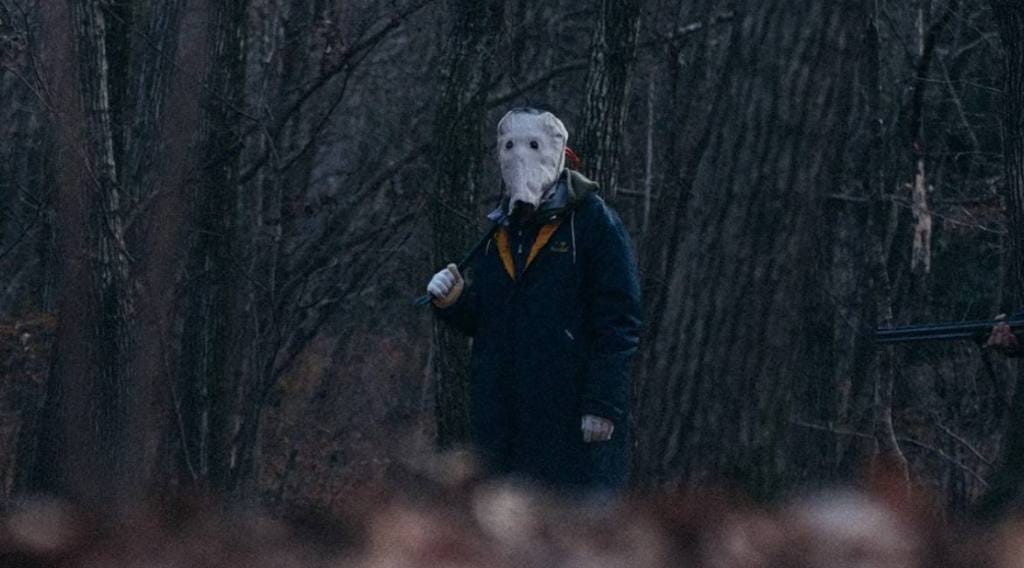
After some initial hints at conflict from the local authorities and some local village teenagers who are jealous of Yoshii’s success, Cloud’s escalation is ultimately stranger and more absurd than its set-up. It is not illogical, exactly, but it is a transposition of the logic of the internet onto the depicted reality Kurosawa has created—a disorienting experience that highlights the way that normalcy online is bizarre when applied to the so-called real. But, as the characters point out, what is real anymore? Is the digital less real? Or has it become more real to us as the century progresses? Are we as much ghosts of the internet now as the ghouls in Pulse, only without any interest in leaving the web? The proceedings are surreal, absurd, thrilling, and ultimately pretty stupid. But that is the world we live in, online and off. For Yoshii, the online logic of cancellation, of trolling, and of cyberbullying among newly formed bands of strangers united by a common enemy sees him facing what seems at first to be the moral consequences of his actions as a man who has achieved profits through the exploitation of producers and consumers alike. Surely someone like Yoshii is the lowest of the low in this late capitalistic online culture, someone without the nobility of creating a product or of having integrity in what he sells. He is neither the mythologized innovator nor salesman. He is just a good grifter.
And yet Kurosawa subverts the idea that this is a morality tale—Death of a Grifter, say—by introducing an improbable and possibly even supernatural element of a savior to guide Yoshii toward safety. The not-exactly-invisible hand of the market smiles on Yoshii, ultimately, a man whose eye for profit and exploitation can seem perverse to viewers looking for traditional ethics but divine, in fact, to the true guiding principles of the world today, which are just as crude and calculated as the end of the road for Fincher’s killer. The demonic takeover of Cloud has no need for internet monsters; it is merely the system that grinds everyone down into profit seekers at the expense of anyone and everyone, even of the world itself—coronating, at last, the grifters as inheritors of the earth. Cloud’s fascinating final scene suggests that the apocalypse, such as it is, has already happened. But who cares? Keep your nose down and keep grinding. It doesn’t make much of a difference anyway.
Cloud is currently playing in theaters around the country.